
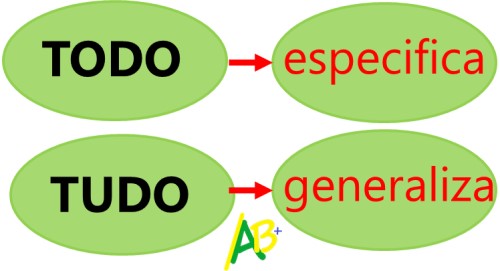
Many Portuguese learners get confused about the difference between tudo vs todo in Portuguese, because both words can be translated as “all” or “everything” in English. However, they are used in different situations. The easiest way to understand the difference is to remember that “todo” is used when you specify what you are talking about, while “tudo” is used when speaking about things in general. The word todo normally appears before a noun and refers to all of a specific thing. For example, in the sentence “Todo dia eu estudo português” (I study Portuguese every day), the speaker specifies the noun dia, so todo is used. Another example is “Todo mundo gosta de música” (Everyone likes music), where todo refers to all people. In contrast, tudo does not refer to a specific noun and instead means everything in general. For instance, in the question “Tudo bem?” (Is everything okay?), the speaker is not specifying any particular thing; they are simply asking if everything is fine. Another example is “Eu entendi tudo” (I understood everything), where tudo refers to all the information or everything that was said. Because of this, tudo usually appears alone and does not need a noun after it. A helpful way to remember the difference between tudo and todo in Portuguese is this simple rule: use todo when the sentence specifies what thing you are talking about, and use tudo when you are talking about everything in a general sense. Understanding the difference between tudo vs todo in Portuguese will help learners speak more naturally and avoid one of the most common mistakes in Portuguese grammar.
If you want to learn more Portuguese with a Brazilian Portuguese Tutor, you can book a trial lesson with 30% off at: